Home
Back to PotSize Bot
Spreadsheets
From a Photograph
When using a photograph we will be measuring the outside of the vessel i.e. the external diameter.
If we are using an existing photograph then we have no control over how it is taken. We may however be in a position to take our own photograph of the vessel even if we are not allowed to measure the capacity directly as described in method 1.
If we are taking our own photograph then the photograph should be taken against a background that contrasts with the vessel so that the outline of the vessel can be clearly seen in the photograph. The photograph should be taken from some distance and level with the midpoint of the vessel. This is to minimise distortion in the photograph caused by parallax. We took photographs from about 6 ft (2 metre).
The photograph should be expanded to about A4 size. The program IrfanView (http://www.irfanview.com) used by the authors has the option to print “best fit to page”. Alternatively the photograph can be expanded using a photocopier. Care must be taken to ensure that the photograph is not distorted or stretched more in 1 direction while it is being enlarged. A good check is to ensure ration of girth to height is the same on the photograph as on the real vessel.
The measurements obtained from the photograph will not be the actually measurements but will be scaled. The spreadsheet produced to carry out this calculation adjusts for this scaling by using the actual height of the vessel.
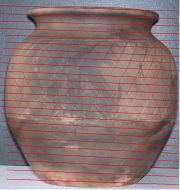 A set of parallel lines 1 cm apart is drawn on the photograph parallel with the base of the vessel. Again there is some difficulty in deciding the position of the first line. In this case we want the line to be across the centre of the base not the front edge. Where this line is will depend on the angle at which the photograph was taken. A vessel with a concave or convex base again causes problems as explained for the pottery illustration. From a photograph it is not possible to tell if the base is flat, or concave. We ignore this and accept that if the base is deeply concave there will be some error in our calculation. As with the illustrations the vessel photography is unlikely to be a whole number of slices. We deal with this in the same way as we did for the illustrations. An added difficulty is deciding where in the photograph the top of the vessel is, again we need the line to be across the centre line if the vessel. We now measure between the two edges of the vessel for each line. As we have measured the outside diameter of the vessel we need to take the thickness of the vessel into account. The provided spreadsheet accepts a value for thickness and subtracts this from the diameters. This makes the assumption that the vessel is of uniform thickness and ignores the thickness of the base. If the thickness of the base is know then this can be used in the positioning of the first line drawn on the photography so that it is aligned with centre line of the top surface of the base.
For either an illustration or a photograph drawing the lines on the will take time and effort and some judgement will be needed in positioning the bottom line. A suggested way of making this easier is to prepare a transparent overlay bearing a set of horizontal parallel lines at 1 cm spacing with a vertical centre line. This overlay is then positioned on the illustration/photograph and the measurements taken along the lines of the overlay. The vertical centre line is needed for illustrations so that the radius can be measured. It should be lined up with the centre line of the illustration. This should be much easier than drawing the lines on the illustration or photograph particularly where a number of vessels are to be measured. Care must be taken to ensure that the position of the overlay does not move while the measurements are being recorded.
Home
Back to PotSize Top
Spreadsheets