Home
Back to PotSize Bot
Spreadsheets
From a Pottery Illustration
In using the pottery illustrations we are leaving the difficulty of taking the measurements to the illustrator. We however must remember that the illustrator will have all the difficulties described above. An experienced pottery illustrator should be able to obtain better results than we could. All our measurements are going to depend on the accuracy of the pottery illustration. It may be that when the pottery illustrations were done they were only intended to give a rough idea of the shape of the vessel. E.g. Orton (1993) p 63 refers to an illustration on an index card. This means that the illustration is only 2 to 3 inches tall. How accurate can this be? However is that is all that is available then it will have to suffice.
If a full size or half scale pottery illustration is available then the measurement can be taken directly from the illustration. However often when reviewing an existing assemblage there may only be small scale illustrations available. If the measurements are taken from these small scale drawing the measurements will not be very accurate. The suggested way of coping with this is to enlarge the illustration of each vessel to about A4 size and take the measurements from this copy. If the small scale drawing is scanned into a computer then a drawing or image viewing program can be used to print each vessel.
The program IrfanView (http://www.irfanview.com/ ) used by the authors has the option to print “best fit to page”. Alternatively the illustration can be expanded using a photocopier. Care must be taken to ensure that the illustration is not distorted or stretched more in 1 direction while it is being enlarged. A good check is to ensure ration of girth to height is the same on the scaled illustration as on the real vessel.
The measurements obtained from the enlarged illustration will not be the actually measurements but will be scaled. The spreadsheet produced to carry out this calculation adjusts for this scaling by using the actual height of the vessel.
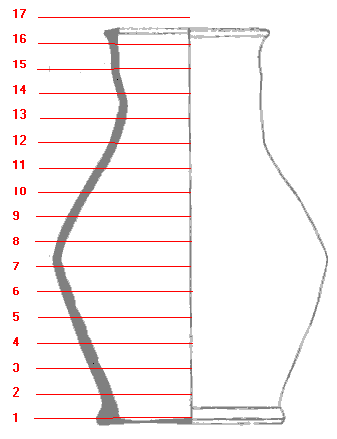 The form of a pottery illustration is such that the easiest measurement to take is that of internal radius and this will remove the thickness of the vessel from the calculation.
A series of horizontal lines at 1 cm intervals is drawn on the illustration with the first line on the base of the vessel. These lines should be parallel with the base and rim of the vessel but these would normally be horizontal.
On each line a measurement of the distance from the illustration centre line to the inside edge of the pot is taken. This gives the inside radius of each slice.
One problem is that the vessel is unlikely to be an exact number of slices high. A solution could be to calculate the volume of the top slice separately using its actual height. This though adds complication to the calculation and is unlikely to make much difference to the accuracy of the calculation. The suggested solution is to look at the top slice, 16/17 in the above picture. If the top of the vessel is nearer to line 17 than line 16 then included the slice, otherwise ignore it.
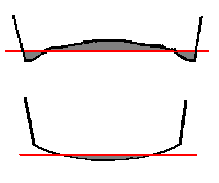 Another problem is if the base of the pottery vessel is not flat then there can be some difficulty in deciding where to position the first line.
For a concave base place the line about half way up the base so that the area of the inside of the vessel below the line is matched by the area of the outside of the vessel that is above the line. This should minimise the error. For a convex base place the line as low as possible to minimise the area of the inside of the vessel that is below the line.
This has covered how to get the measurements from the pottery illustration.
Home
Back to PotSize Top
Spreadsheets