Home
Back to PotSize Bot
Spreadsheets
Method 3 – Using Regular Shapes
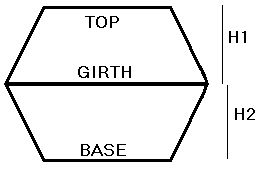 A simple way to do this is to treat the vessel as a shape for which the capacity can easily be calculated. The shape selected is that of a double truncated cone as shown on the right. Many vessels do have this general shape being narrower at the top and bottom. A major advantage of this shape is that the capacity can be calculated using the values that are normally recorded for vessels. In most vessel assemblages the values recorded for a vessel are rim diameter, girth diameter, base diameter, and height and these are the values needed to calculate the volume of a truncated cone.
The volume of a truncated cone is given by
Volume = 1/3 p (r12 + r1 * r2 + r22 ) h
Where r1 is the radius of the top
r2 is the radius of the base
h is the height of the truncated cone.
So the volume of the truncated cones can be calculated from the values available.
In these calculations the measurements must be the internal dimensions of the vessel. These are obtained by subtracting the thickness from the HEIGHT and subtracting twice the vessel thickness from the TOP, GIRTH, and BASE.
An Excel spreadsheet is available to carry out these calculations.
This method is subject to a number of errors: -
- The vessel will not actually be a double truncated cone. The greater the difference in shape from a double truncated cone the greater the error.
- If a vessel has a throat that is much smaller than the rim then using the rim diameter will over estimate the capacity. It may be worthwhile to use the diameter of the throat (if available) if this is the case.
- The calculation assumes that the widest part of the vessel (the girth) is at half the height of the vessel.
- A single value is used for the vessel thickness. Vessels are unlikely to be of uniform thickness.
Home
Back to PotSize Top
Spreadsheets